Oct 13, 2026Buying Guides
Band Saw Blade TPI Chart for Metal Bars and Tubes
Use LIANJI's factory TPI starting ranges for solid bars, steel tubes and profiles. Learn why wall thickness and tooth engagement matter more than outside size alone.
To choose band saw blade TPI, determine the section of metal that the teeth actually meet. Large solid bars usually need a coarser pitch with room for chips; thin-wall tubes generally need more teeth engaged. LIANJI's quick chart and expanded selection guide provide starting points, but their boundary ranges overlap. For tubes, check outside diameter together with wall thickness. Adjust the initial choice for machine condition, blade grade and the cutting result you need.
Why tooth pitch changes the cut
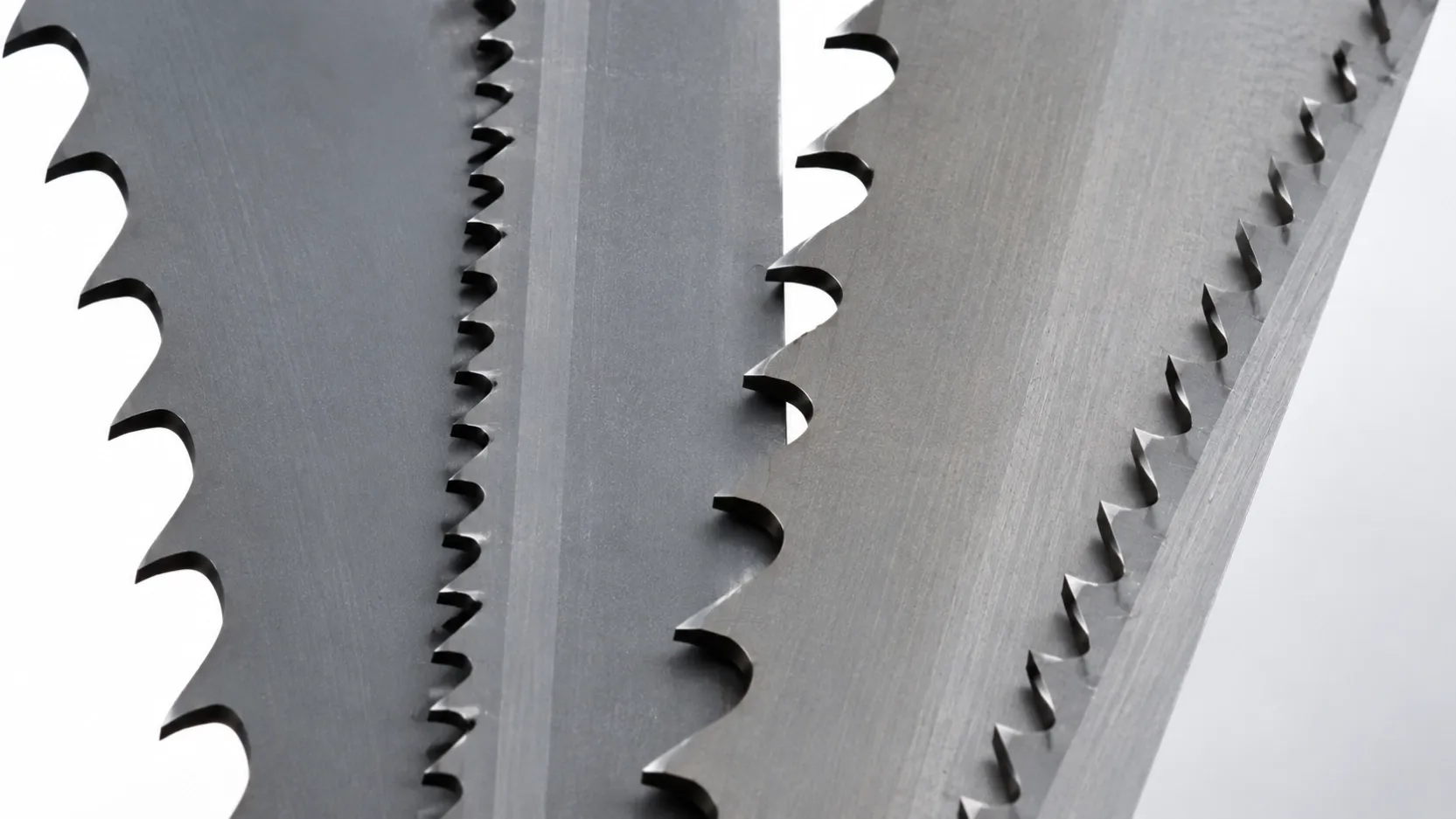
TPI is the number of teeth along one inch of blade edge. Low TPI means teeth are spaced farther apart. The larger spaces between teeth, called gullets, have more room to carry chips away. High TPI puts more teeth into a short length of blade, which can help stabilize the cut across a thin wall.
On a thick solid section, too many closely spaced teeth may produce chips faster than the gullets can carry them out. Chips can pack into the cut, raising heat and cutting resistance. On thin tube walls, a pitch that is too coarse can leave very few teeth engaged at once. Each engaged tooth then takes a higher load, which can contribute to vibration, rough cuts or broken teeth. The goal is a useful balance, not the largest or smallest TPI available.
LIANJI factory starting chart
The following ranges combine LIANJI's quick catalog chart with its expanded selection guide. A notation such as 3/4 denotes variable pitch, not a fraction of one tooth per inch. Adjacent sizes may have more than one usable pitch. The guide also distinguishes tooth form, including anti-tooth-stripping forms for some hollow or irregular sections. Confirm the proposed form and blade grade with the supplier.
Workpiece or cutting section | Starting tooth pitch |
Non-solid or irregular section, wall under 3 mm | 5/8; 4/6 anti-stripping is another catalog option |
Non-solid or irregular section, wall 3–10 mm | 4/6; 3/4 anti-stripping is another catalog option |
Solid stock, Ø100–150 mm | 3/4, with 2/3 also listed in a detailed range |
Solid stock, Ø150–200 mm | 3/4 or a coarser option such as 2/3, depending on the cut |
Steel tube, wall 10–20 mm | 3/4 in the quick chart; check the OD-by-wall-thickness matrix |
Solid stock, Ø200–300 mm | 2/3 |
Steel tube, wall over 20 mm | 2/3 |
Solid stock, 300–500 mm | 1.4/2 |
Solid stock, 500–800 mm | 1/1.5 |
Solid stock, over Ø800 mm | 0.75/1 in the quick chart; 0.75/1.25 appears in the expanded guide |
The original quick table describes its figures as factory test data. The expanded guide gives alternative pitches at some boundaries and a separate tube matrix by outside diameter and wall thickness. Neither identifies every alloy, hardness or machine used. Treat each row as a first selection to verify, especially on stainless steel, hardened steel or an unusual profile. Material hardness mainly affects blade grade and cutting conditions; it does not replace section geometry when choosing tooth pitch.
Solid bar and tube can have the same OD but need different pitch
Consider a Ø200 mm solid bar and a tube with Ø200 mm outside diameter and a 5 mm wall. The bar presents a long cutting path through solid metal and produces substantial chips. The tube presents thin walls and changing tooth engagement. LIANJI's quick chart points toward 3/4 or 2/3 around the Ø200 mm solid boundary; its detailed tube matrix lists 4/6 for an approximately 200 mm OD tube with a 4–6 mm wall. Using outside diameter alone would miss the difference.
For square tube, channel, I-beam or bundled stock, the blade may enter several walls or pieces during one cut. LIANJI's expanded guide recommends checking tooth engagement through the effective cutting length and lists special anti-stripping forms for thin profiles. Provide a sketch showing the section and orientation. A stack of loose tubes may also need a different clamping plan. Tooth pitch cannot compensate for work that shifts under the blade.
Constant pitch or variable pitch?
Constant pitch repeats one tooth spacing. Variable-pitch markings such as 2/3, 3/4 and 4/6 describe a pattern with different spacing along the edge. Changing tooth spacing can help disrupt repetitive forces and vibration in some applications, particularly when tooth engagement changes through a tube or profile. The right pitch still depends on the smallest wall being entered, total section, material and machine setup.
Do not read “3/4” as the blade's thickness or length. An order needs the complete specification: blade length × width × thickness, blade grade and TPI. LIANJI's catalog lists basic blade sections from 27 × 0.9 to 80 × 1.6 mm, but the correct length and permissible section come from the saw model. If replacing a blade, confirm its marking against the machine manual before ordering.
Check the result and adjust one variable at a time
If chips pack into the gullets on a large solid, investigate whether the pitch is too fine as well as the feed, brush and coolant. If thin tube walls snag or teeth break, investigate whether too few teeth are engaged, whether the work is clamped firmly and whether the feed is excessive. When the cut wanders or the blade wears quickly, check guides, tension and blade grade too. A pitch change alone may not solve a machine setup problem.
Record material grade, hardness, dimensions and wall thickness, blade size and grade, TPI, speed, feed and cut result during a trial. Compare acceptable cut quality and blade life as well as cycle time. For a difficult material, ask LIANJI to recommend both the blade grade and a starting pitch rather than treating this table as a fixed prescription.
For the full grade comparison, read our guide to M42, M51, M51+, M71 and carbide-tipped blades. If you are selecting the entire cutting system, start with our general band saw blade guide. Send the workpiece dimensions and your saw model to LIANJI for a blade and TPI recommendation