Oct 13, 2026Buying Guides
How to Choose a Band Saw Blade for Metal Cutting
Select a metal cutting band saw blade by material, cross-section, TPI, blade grade and machine fit. Use LIANJI product examples to prepare an inquiry.
Start with the metal and the section the blade must cut. A blade for a large solid carbon-steel bar may not suit a thin-wall stainless-steel tube, even if both have the same outside diameter. Choose the blade grade for the material and cutting demands, tooth pitch for the section, and dimensions for the saw. Then confirm band speed, feed, coolant and clamping on the actual machine.
Start with the workpiece
Record the exact material grade rather than saying only “steel.” Carbon steel, stainless steel, tool steel and nickel alloys do not place the same demands on a tooth edge. If the material is heat-treated, provide its hardness. Next, specify whether the workpiece is a solid round or rectangular bar, a tube, an open structural profile or a bundle. A photo or drawing helps when the section is irregular.
For tube and structural material, give wall thickness as well as outside dimensions. As the blade crosses a tube wall, tooth engagement changes. A large solid bar keeps more teeth cutting and generates a larger volume of chips. These differences affect tooth pitch and chip clearance; outside diameter alone is not enough for selection.
Choose a blade grade for the material
LIANJI's supplied catalog places M42 as a general-purpose bi-metal starting point for basic cutting, including carbon and low-carbon steel, aluminum and copper. It lists M51 for a broader range that includes structural and alloy steels, cast iron, tool steel and stainless steel. M51+ has an optimized tooth form described for difficult materials, including stainless steel. M71 uses powder-metallurgy high-speed-steel teeth for demanding steels, while the separate carbide-tipped option targets high-hardness steel, surface-hardened material, titanium, nickel and high-temperature alloys.
This sequence is a way to investigate options, not an automatic ranking of what every buyer should purchase. The best grade depends on the specific alloy, hardness, machine stability, section size and acceptable cost per cut. Carbide tips, for example, are not automatically economical on routine carbon steel. Ask for a representative test before changing grades on an expensive or difficult job.
For a detailed comparison of LIANJI M42, M51, M51+, M71 and carbide-tipped blades, read the companion blade-grade guide. Each product page should identify the actual blade offering rather than imply that one material list guarantees the same result on every saw.
Select TPI from the section in the cut
TPI means teeth per inch. A coarser pitch leaves more space between teeth to carry chips from thick solid sections. A finer pitch generally keeps more teeth engaged on thin-wall material. A pitch that is too fine for a large solid can clog with chips; one that is too coarse for a thin wall can overload individual teeth and increase vibration or tooth damage.
LIANJI's quick chart lists 3/4 TPI for Ø100–200 mm solid stock, 2/3 for Ø200–300 mm, and 1.4/2 for 300–500 mm. Its more detailed guide also allows coarser alternatives within parts of the 100–200 mm range. For tubes it considers both outside diameter and wall thickness, not one dimension alone. These are starting options rather than a guarantee for every alloy or machine. The dedicated TPI guide explains the chart and where its ranges overlap.
Confirm tooth form and machine fit
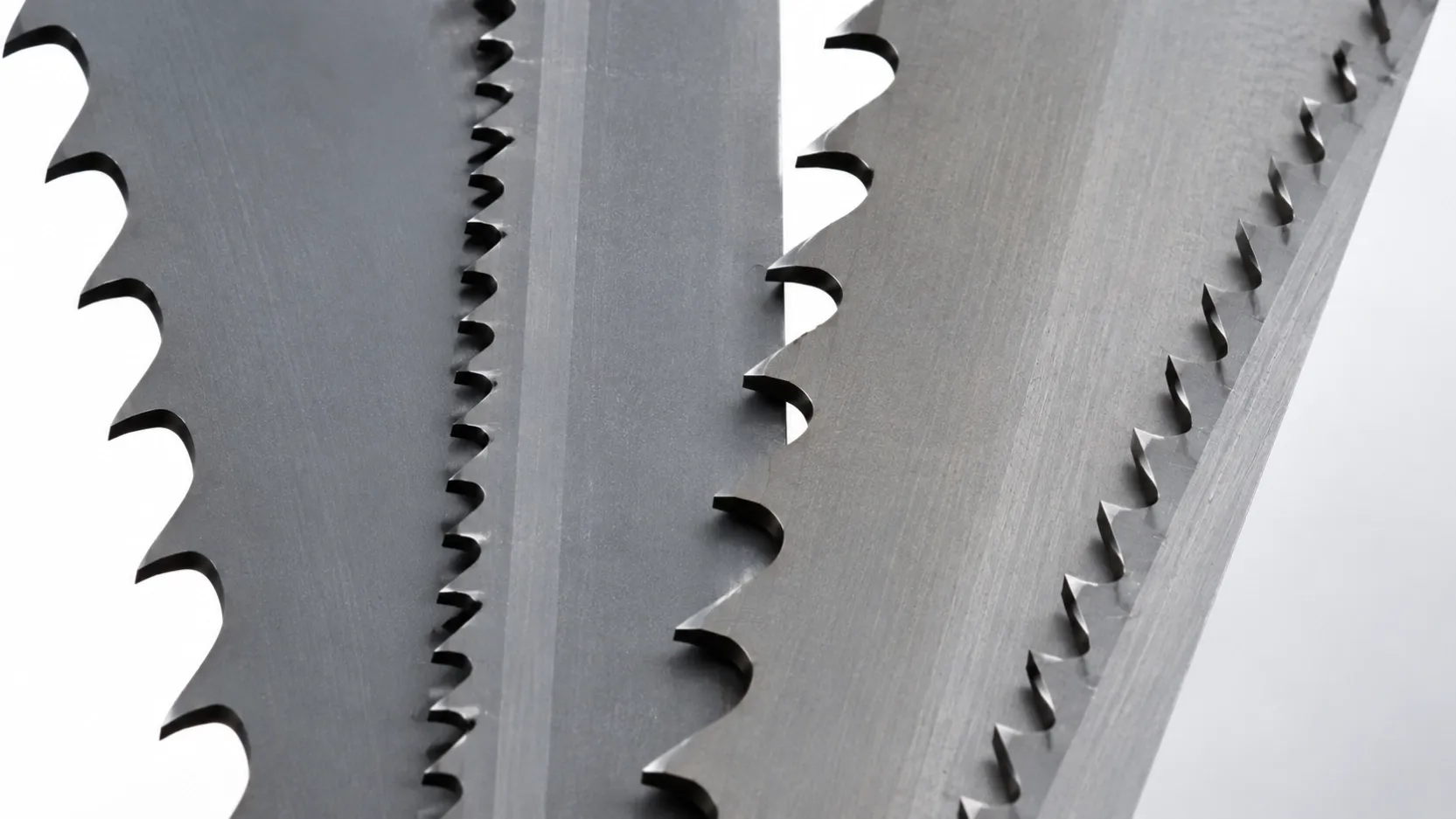
Tooth spacing is only part of the cutting geometry. The tooth form, rake and gullet influence how teeth enter the work and how chips escape. LIANJI's M51+ catalog describes a shallow-tooth design intended to help chip evacuation and reduce resistance in stainless-steel cutting. Ask whether that geometry fits your material and production conditions rather than selecting from hardness alone.
Before ordering, read the blade size printed on the current blade or the saw's manual: length × width × thickness. LIANJI's catalog lists basic cross-sections such as 27 × 0.9, 34 × 1.1, 41 × 1.3, 54 × 1.6, 67 × 1.6 and 80 × 1.6 mm. These are section sizes, not universal blade lengths. The machine's wheels, guides and tensioning system determine what it can accept. Include the blade length and TPI in your inquiry.
Check the cutting setup before judging the blade
A suitable blade can still perform poorly with inadequate tension, worn guides, unstable clamping, poor chip removal or coolant that misses the cut. Band speed and feed must allow teeth to form and carry chips without excessive loading or rubbing. If a blade fails early, record the machine model, material, blade grade and pitch, speed, feed, coolant condition and failure pattern before blaming the tooth material.
For a new blade, follow a break-in procedure appropriate to the blade and workpiece rather than starting at full production load by default. The catalog describes a relatively short break-in for LIANJI M42, but it does not provide a universal setting for every material and saw. Ask the supplier for a procedure matched to your application.
Send LIANJI the material grade and hardness, workpiece shape and dimensions, band saw model, current blade size and tooth pitch, and the problem you want to solve. These details make a blade recommendation more useful than a request for “one general-purpose blade.” Explore the Band Saw Blades range or contact the team for a recommendation based on your cutting job.