Buying Guides
M42 vs M51 Band Saw Blades: Which Should You Choose for Metal Cutting?
Compare M42 vs M51 band saw blades for metal cutting. Learn when to keep M42, when to trial M51, and how to calculate blade cost per acceptable cut.
If your M42 blade cuts mild steel straight and delivers predictable blade life, keep it as your baseline. If its teeth wear evenly but too quickly on a recurring alloy-steel or tool-steel job, M51 is worth a controlled trial. The decision comes down to how many acceptable parts each blade produces, how often the saw stops for a blade change, and what those results cost.
What Is the Difference Between M42 and M51?
M42 and M51 identify the high-speed steel used at the cutting edge of a bimetal blade. The backing, tooth form, and pitch also affect how the finished blade performs. Two M42 blades can serve quite different jobs. One may be designed for general shop use, while another uses a tooth profile developed for tubes and structural sections.
Selection Factor | LianJi M42 | LianJi M51 |
Typical applications | Routine cutting of mild steel and carbon steel, plus selected non-ferrous metals | A broad range of steels, including structural, alloy, and tool steels |
When to consider it | Your current setup meets cut-quality and blade-life requirements | Tooth wear limits blade life on a recurring job despite a suitable setup |
What to confirm | Blade dimensions, pitch, and tooth form | Machine fit, pitch availability, and cutting settings for the specific material |
When to Keep M42
A fabrication shop cutting mild-steel stock throughout the week can use its current M42 blade as a benchmark. Record the number of acceptable cuts before replacement and why the operator removed the blade. If those results are consistent and meet production needs, you already have a useful baseline for evaluating any change.
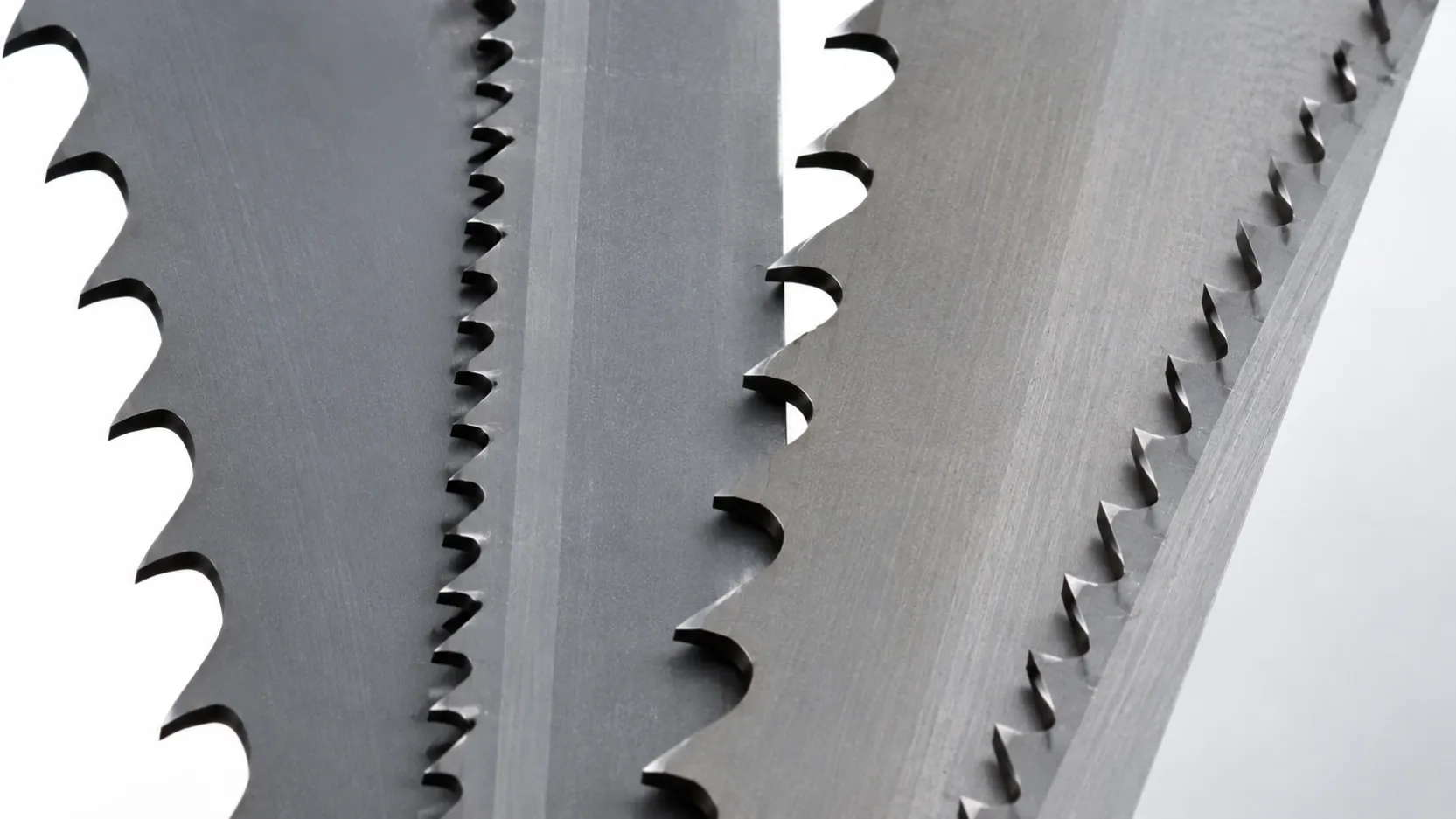
If trouble starts when you switch from solid bars to thin-wall tubes, check tooth pitch and clamping first. A pitch that works on solid stock may leave too few teeth engaged as the blade enters a thin wall. A more suitable tooth form or pitch may improve the tube cut while keeping the M42 cutting edge.
When M51 Is Worth Testing
Suppose you cut the same alloy-steel bar every week. Your M42 blade tracks straight and clears chips, but the teeth wear down before you finish a typical batch. If the wear is relatively even and you’ve confirmed the pitch, speed, feed, and coolant are appropriate, trial an M51 blade on bars from the same material lot. Compare the number of acceptable cuts and how often you stop to replace the blade.
The reason you remove the old blade matters. Missing or chipped teeth call for a review of pitch, clamping, feed, and break-in. Crooked cuts or one-sided wear point to checks on the guides, tension, and alignment. A broken band warrants a photo of the fracture and a note on whether it started near the loop weld, a tooth gullet, or the back edge. These observations help you decide whether a grade trial addresses the problem you’re seeing.
How to Run a Fair M42 vs M51 Trial
Use the same saw, material lot, and workpiece dimensions. Match both blades to the machine’s specified length, width, and thickness. Use the same pitch and tooth form where available if you want to isolate the effect of tooth grade. If the blades require different geometries or operating settings, record those differences and compare them as two complete setups.
Follow the supplier’s break-in guidance for each blade. Before cutting, agree on what counts as an acceptable part, such as a squareness tolerance or surface-finish requirement. Apply the same criteria to both runs.
For each trial, record blade dimensions, tooth form and TPI, material grade and hardness if known, section size, band speed, feed, coolant and break-in procedure. Then record acceptable cuts, typical cycle time, blade price, and reason for replacement.
Calculate Blade Cost per Acceptable Cut
Divide the blade purchase price by the number of acceptable cuts. In an illustrative example, an M42 blade costing 40 USD and producing 200 acceptable cuts costs 0.20 USD per cut. An M51 blade costing 55 USD needs 275 acceptable cuts to match that figure. At 300 acceptable cuts, its blade cost falls to about 0.18 USD per cut.
Compare cycle time, scrap, and blade-change downtime separately. On a saw that limits production, a longer run between blade changes can matter even when blade cost per cut is similar.
What to Send LianJi Before Ordering
Share your saw model, blade length × width × thickness, tooth pitch, workpiece material and dimensions, and the problem you want to solve. For tubes and profiles, include wall thickness. If blade life is the issue, tell us how many acceptable cuts you get now and why the blade comes off the saw. That gives us a starting point for recommending an M42 or M51 trial. Contact LianJi for Blade Selection