Buying Guides
Band Saw Blade Speed Chart for Metal Cutting
Recommended band saw blade speeds for metal cutting by material — mild steel, stainless, aluminum, titanium and more — in m/min and SFPM, plus how to set feed by reading the chips.
Blade speed is the second setting that decides blade life, after tooth pitch. Run too fast and the teeth overheat and dull early; run too slow and the teeth rub instead of cutting, work-hardening the surface. This chart gives starting speeds for bi-metal band saw blades by material — then the chips tell you how to fine-tune.
Quick rule: the harder and tougher the material, the slower the blade. Start at the low end of the range for large solid sections and unfamiliar materials. Silver, tightly curled chips mean the settings are close; blue chips mean too much heat — slow the blade down before changing anything else.
Band saw blade speed chart (bi-metal blades)
Material | Blade speed (m/min) | Blade speed (SFPM) | Notes |
Aluminum and aluminum alloys | 90–150 | 300–500 | Coarse pitch clears the soft, bulky chips |
Brass and bronze | 75–105 | 250–350 | Free-cutting; standard coolant is enough |
Copper | 45–75 | 150–250 | Soft but grabs — keep the feed steady |
Low-carbon (mild) steel | 60–90 | 200–300 | The general-purpose starting point |
Medium-carbon steel | 55–75 | 180–250 | Slow down as carbon content rises |
Structural steel (beams, channel, angle) | 50–80 | 165–260 | Interrupted cuts — pitch matters as much as speed |
Alloy steel, annealed (e.g. 4140) | 45–60 | 150–200 | Harder in the as-rolled state; check hardness if unsure |
Cast iron | 35–55 | 110–180 | Abrasive scale; many shops cut it dry |
Tool and die steel | 25–40 | 80–130 | High-alloy grades sit at the low end |
Stainless steel (304 / 316) | 25–40 | 80–130 | Work-hardens — never let the blade dwell or rub |
Titanium alloys | 15–25 | 50–80 | Heat stays in the teeth; use flood coolant |
Nickel alloys (Inconel, Monel) | 12–20 | 40–65 | The slowest group; M51 or carbide territory |
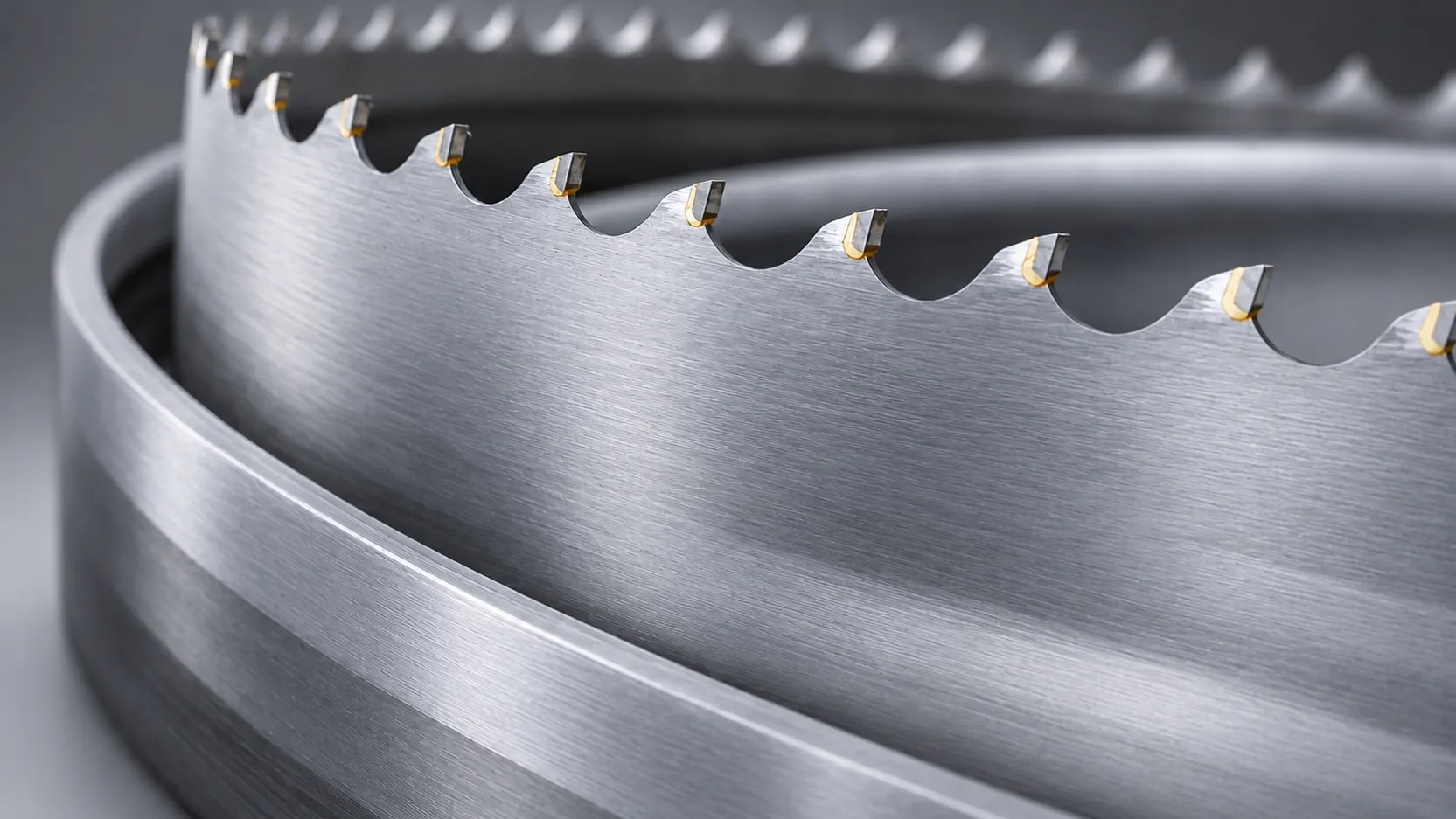
These speeds are starting points for bi-metal blades cutting solid sections with coolant. Use the lower end for large sections (over 150 mm), bundle cutting and interrupted cuts; the upper end suits small sections. For hardened steels above about 45 HRC, switch to a carbide-tipped blade instead of slowing a bi-metal blade down.
Setting the feed: let the chips talk
Feed rate is how fast the blade moves down into the workpiece. It decides how big a chip each tooth takes. If the feed is too light, the teeth rub across the surface instead of cutting into it. If it is too heavy, the gullets fill up with chips and the teeth can strip. The easiest way to tell whether the feed is right is to look at the chips:
Chip appearance | What it means | Adjustment |
Thin, powdery or needle-like chips, silver color | Teeth are rubbing, not cutting — feed too light | Increase the feed rate |
Tightly curled chips, silver to light straw color | Correct chip load | Keep the settings |
Thick, heavy chips, blue or dark straw color | Too much heat — speed too high for the load | Reduce blade speed first, then re-check |
Chips packed or welded in the gullets (common on aluminum) | Gullets overloaded | Coarser pitch, more coolant, or slightly less feed |
Speed works with pitch and blade grade
Set the tooth pitch first, from the section size, using our band saw blade TPI chart; then set the speed from the material using the chart above. Blade grade matters at the slow end of the chart: on stainless, tool steel, titanium and nickel alloys, an M51 blade keeps its edge where M42 wears quickly — see our M42 vs M51 comparison for where each grade pays off.
FAQ
- What blade speed should I use for mild steel?
With a bi-metal blade, 60–90 m/min (200–300 SFPM) covers most low-carbon steels. Start near 60 m/min for large solid sections and move up for small bars and tubes.
- Why does my blade dull quickly on stainless steel?
Usually the speed is too high or the feed too light. Stainless work-hardens: if the teeth rub instead of biting, the surface hardens and wears the edge even faster. Keep the speed at 25–40 m/min and the feed firm enough to keep cutting.
- Can I cut aluminum at steel speeds?
It will cut, but slowly, and the soft chips pack into the gullets and can weld to the teeth. Aluminum wants 90–150 m/min with a coarse pitch so the chips clear.
- What happens if the blade speed is too high?
The teeth overheat, lose hardness and wear flat, cutting slows down and the cut can wander. Blue or dark straw-colored chips are the early warning — reduce the speed before the edge is damaged.
For the full selection process, see our guide on how to choose a band saw blade for metal cutting, or send LIANJI your material, section size and machine model via the contact page and we will recommend a blade and starting settings.