Buying Guides
M51 vs M51+ Band Saw Blades: Which Should You Choose?
Compare LianJi M51 and M51+ band saw blades. Learn when to trial M51+ for stainless steel and how to compare blade cost per acceptable cut.
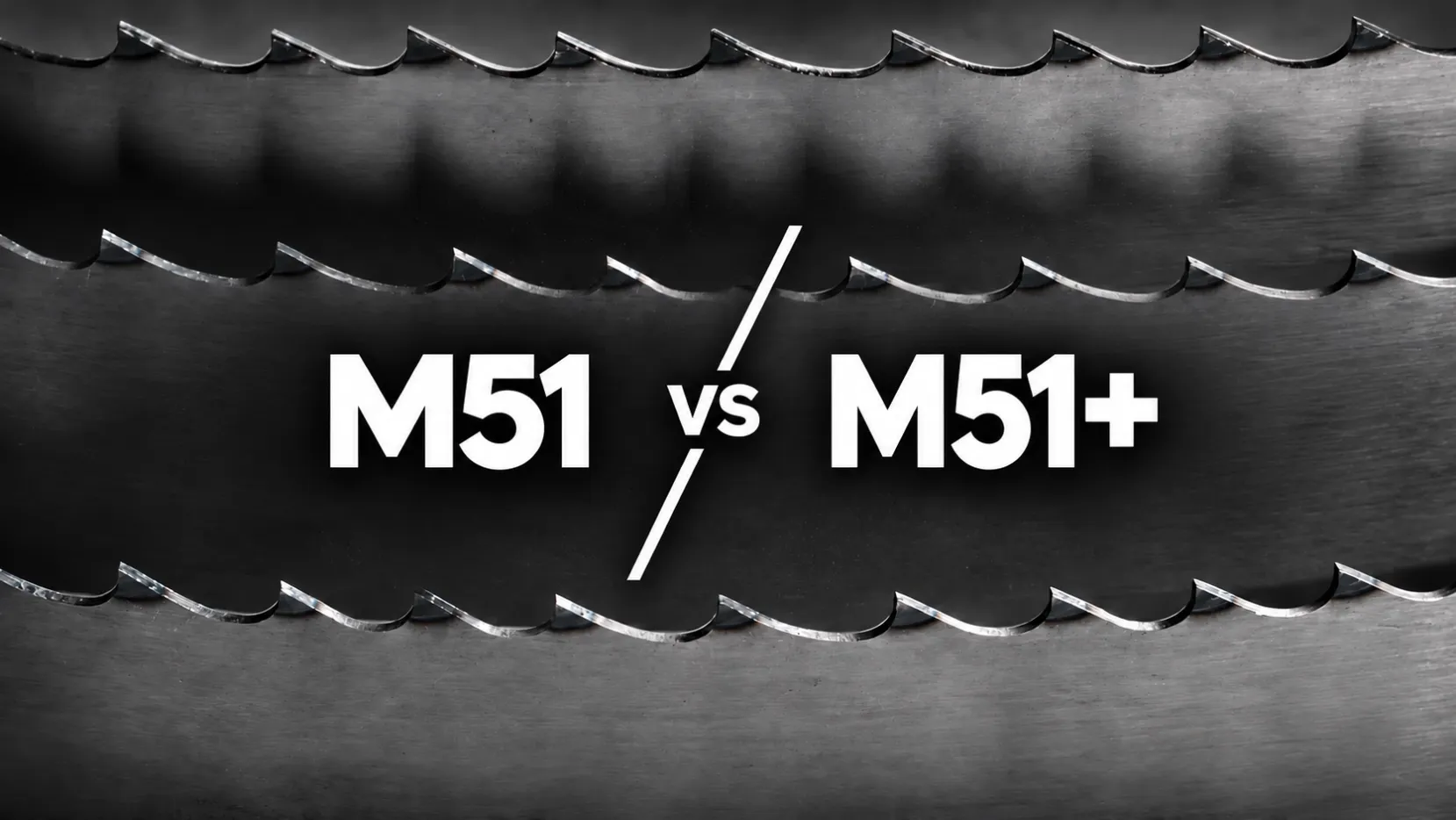
Both LianJi M51 and M51+ bi-metal band saw blades can cut stainless steel. If your M51 blade delivers square cuts, clears chips consistently, and lasts through a typical batch, it is a useful baseline. If you cut stainless steel regularly and see a recurring problem with tooth loading or chip evacuation, M51+ is worth a controlled trial. Its tooth geometry is designed with those cutting conditions in mind.
M51 vs M51+ Band Saw Blades at a Glance
Selection Factor | LianJi M51 | LianJi M51+ |
Cutting edge | Heat-treated M51 high-speed steel teeth | High-speed steel teeth with optimized variable-pitch geometry |
Catalog tooth hardness | 68–69.5 HRC | 68.5–70 HRC |
Application focus | A broad range of steels, including structural, alloy, tool, and stainless steels | Stainless steel and other demanding steel-cutting applications |
Where to start | Mixed production or jobs where M51 already gives repeatable results | Recurring stainless steel jobs where chip evacuation or tooth loading deserves a closer look |
The hardness ranges overlap. They describe the blade teeth, and the hardness of the material a blade can cut must be assessed separately. For a buying decision, compare the available tooth form and pitch for your workpiece, then confirm the blade dimensions for your saw. LianJi M51 LianJi M51+
When M51 Is a Good Starting Point
Consider M51 if your shop cuts a mix of structural steel, alloy steel, tool steel, and occasional stainless jobs. For instance, a shop that cuts several grades of solid bar in short runs can use M51 as a baseline for the jobs it repeats. Track how many parts meet the required squareness or surface finish and why the blade comes off the saw.
If only one job causes trouble, compare it with the jobs that run well. A change in bar diameter, material condition, or cutting setup can explain why the same blade behaves differently. That comparison helps you decide whether to trial M51+ on the problem job or adjust the existing M51 setup.
When M51+ Is Worth Testing
M51+ is a candidate when stainless steel makes up a recurring part of your workload. Suppose your shop cuts the same lot of 304 stainless round bar and regularly finds chips packed between the teeth as the blade reaches the widest part of the cut. First check whether the pitch leaves enough room for chips and whether the chip brush and coolant are working as intended. If the problem persists with a suitable setup, trial an M51+ blade in a pitch matched to that bar.
Thin-wall stainless tube presents a different problem. At the same outside diameter, a tube changes how many teeth are engaged as the blade enters and leaves the walls. If you see chipped teeth on tube jobs while the same blade cuts solid bar well, check the wall thickness, tooth pitch, and clamping first. Use both outside diameter and wall thickness when specifying either M51 or M51+. Band Saw Blade TPI Chart
How to Run a Fair M51 vs M51+ Trial
Use the same saw, material lot, and workpiece dimensions. If both blades are available in the same nominal TPI, use it to reduce one source of variation. Record the tooth form for each blade because the same TPI can come with different tooth geometries. Follow the supplier’s break-in guidance and record the speed, feed, and coolant conditions for both runs.
Before starting, agree on what counts as an acceptable cut. Use a measurable requirement such as squareness, surface finish, or machining allowance. Then record the number of acceptable cuts, typical cycle time, and reason for blade replacement. Photograph any unusual tooth wear or chip packing so you can compare how the two blades finished the trial.
Divide the blade price by the number of acceptable cuts to compare blade cost per cut. For illustration, if M51 costs 60 USD and produces 300 acceptable cuts, its blade cost is 0.20 USD per cut. An M51+ blade costing 72 USD needs 360 acceptable cuts to match that figure. If the two blades have similar costs per cut, compare cycle time and blade-change downtime to see which fits the job better.
What to Send LianJi for a Recommendation
Share the material grade and hardness if known, workpiece shape and dimensions, saw model, and current blade length × width × thickness and TPI. For tubing, include wall thickness. If you want to improve a recurring stainless job, tell us what limits the current blade and how many acceptable cuts you get before replacement. That gives us a starting point for recommending an M51 or M51+ trial. Contact LianJi for Blade Selection